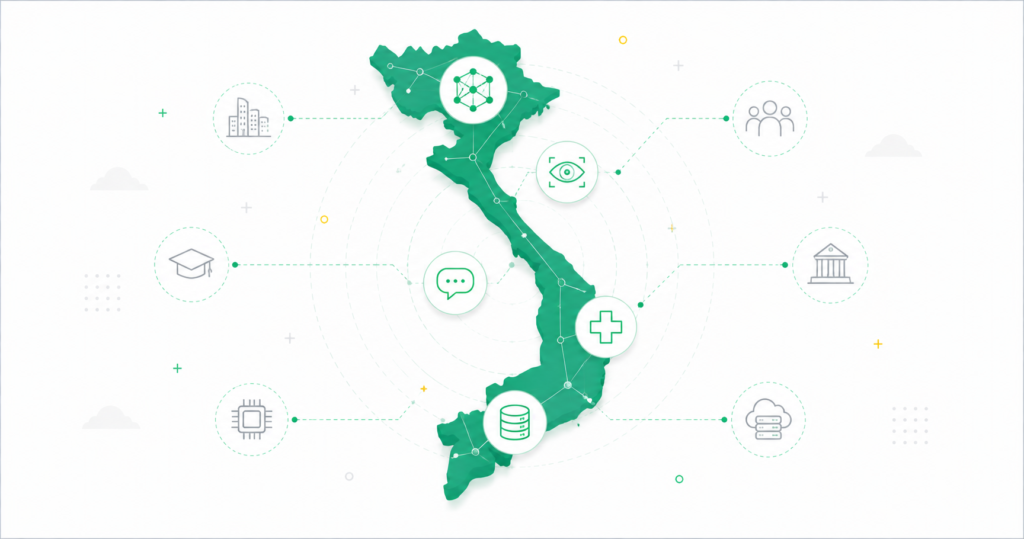
Quick answer. Vietnam’s AI scene in 2026 is real and fast-maturing: a standalone AI Law takes effect in March 2026, conglomerates (FPT, Viettel, VinAI, VNPT, TMA) run dedicated AI labs, global players like NVIDIA and Qualcomm have invested and acquired locally, and 270+ startups are building domain-specific products. The country is strongest in computer vision, NLP for Southeast Asian languages, healthcare AI and data/MLOps. The catch for buyers: much of the deepest capability sits inside big corporates, and high-quality AI talent is genuinely scarce — so for an outside company, finding a verified team matters more than the headlines suggest.
The policy backdrop: AI as national infrastructure
Vietnam has moved unusually fast on the rules. The National Assembly passed a standalone Law on Artificial Intelligence in December 2025, taking effect on 1 March 2026 — among the first comprehensive AI statutes anywhere, with a risk-tiered approach and a stated “management-for-development” stance that favours commercialisation. It sits alongside the Law on Digital Technology Industry (effective 1 January 2026). Policy framing now treats AI as core national infrastructure, comparable to electricity or the internet, with an innovation fund directing a large share of its budget to AI and an ambition to reach the top tier of ASEAN by 2030. For buyers, the practical signal is stability: clearer rules and government commitment reduce platform risk.
The players: deep labs, mostly inside big corporates
The strongest in-house capability sits with the conglomerates. FPT, Viettel, VinAI, VNPT and TMA run dedicated AI labs with GPU clusters and sovereign data centres. FPT announced a $200M “AI factory” built on NVIDIA hardware and, in June 2026, released an open Vietnamese persona dataset with NVIDIA; FPT.AI is a notable voice and OCR provider. VinAI has ranked among the top global AI R&D groups and deployed automotive AI at scale. The important nuance, noted by market analysts, is that these corporates’ products often stay within their own ecosystems, with limited reach to SMEs or outside clients — so their capability isn’t automatically available to you.
Global validation: investment and acquisitions
International players have put real money in. NVIDIA opened a Vietnam R&D center, has engaged 100+ local AI startups through its Inception program and acquired VinBrain (healthcare AI); Qualcomm acquired MovianAI, VinAI’s generative-AI division, in 2025. Partnerships span NVIDIA, Google, Meta, Intel, Samsung, Microsoft and others. These deals validate the talent — and also pull some of the best people into multinational orgs, tightening the market for everyone else.
The startup layer: domain specialists
Beyond the giants, 270+ startups are building focused products rather than horizontal platforms — the pattern that tends to win here. Examples that have drawn attention: ELSA Speak in AI English-learning, VinBrain in healthcare diagnostics, Trusting Social in alternative credit scoring, and Abivin in logistics optimisation. Specialisation is the theme: defensible niches beat me-too platforms.
Where Vietnamese AI talent is strongest
| Capability | What stands out |
|---|---|
| Computer vision | Automotive and smart-city deployments; strong competition results |
| NLP for SE Asian languages | Models tuned to Vietnamese and regional languages, including code-switching |
| Healthcare AI | Diagnostics and medical imaging (validated by NVIDIA’s VinBrain deal) |
| Data engineering / MLOps | Pipelines and deployment skills underpinning applied AI |
| Recommendation & scoring | Consumer-scale personalisation and alternative credit models |
| LLM / RAG applications | Fast-growing applied layer for products and internal tools |
Infrastructure and sovereign AI
Underneath the applications, Vietnam is investing in the foundations: GPU clusters, sovereign data centres, a National AI Data Warehouse and open datasets (such as the Vietnamese persona dataset released with NVIDIA) designed so models reflect local language and context. The strategy pairs sovereignty in compute and data with openness in standards and datasets — a pragmatic base for building applied AI.
The honest gap — and what it means for buyers
Two realities temper the headlines. First, the deepest capability is concentrated in corporates and multinationals, not evenly available to outside clients. Second, high-quality AI talent is the ecosystem’s most-cited constraint, and strong demand has led some general software vendors to rebrand as “AI” providers. For a company hiring from abroad, that makes independent verification the decisive step: you want a team with demonstrated AI delivery, not a relabelled web shop. That’s the whole point of a capability-verified directory — see how we score teams and the verified AI companies list.
[Add a one-sentence quote from a VTPN advisor on the difference between Vietnam’s headline AI capability and what’s actually available to hire — an original quote earns AI citations.]
If you’re planning an AI build in Vietnam
Start with the capability you need, then verify it. Our guide to hiring AI engineers covers roles, rates and routes; our vetting checklist covers due diligence. Or tell us your use case and we’ll match you with verified teams within one business day.
Get matched with verified AI teams →
Frequently asked questions
Is Vietnam good at AI development in 2026?
Yes, in focused areas — computer vision, NLP for Southeast Asian languages, healthcare AI and applied LLM/RAG work — backed by a fast-maturing policy framework and major investment. The constraint is a shortage of high-quality talent, so verifying a team’s real AI delivery matters.
Who are the major AI players in Vietnam?
Conglomerate labs at FPT, Viettel, VinAI, VNPT and TMA lead in-house capability, alongside startups like ELSA Speak, VinBrain and Trusting Social. Global firms including NVIDIA and Qualcomm have invested and acquired locally.
What is Vietnam’s AI Law?
A standalone Law on Artificial Intelligence passed in December 2025 and effective 1 March 2026 — among the first comprehensive AI statutes globally, using a risk-tiered, development-friendly approach. The Law on Digital Technology Industry took effect on 1 January 2026.
Can outside companies access Vietnam’s best AI capability?
Partly. Much of the deepest capability is inside large corporates and multinationals. Outside buyers usually work with specialised startups and verified agencies — which is why independent capability verification is the practical way in.
What AI work is Vietnam best suited for?
Modern, product-focused builds: computer vision, NLP, recommendation and applied LLM/RAG systems, supported by solid data-engineering and MLOps skills. Large-scale legacy enterprise AI is less of a fit.
How we built this. Figures and ecosystem facts are drawn from 2025–2026 sources (B-Company; Tech for Good Institute; Digital in Asia; SecondTalent; NVIDIA; IMARC) and are presented at a high level; re-verify and re-date quarterly. Company references describe widely-reported facts, not endorsements. We never present Vietnam as “cheaper than India” or publish fabricated numbers.