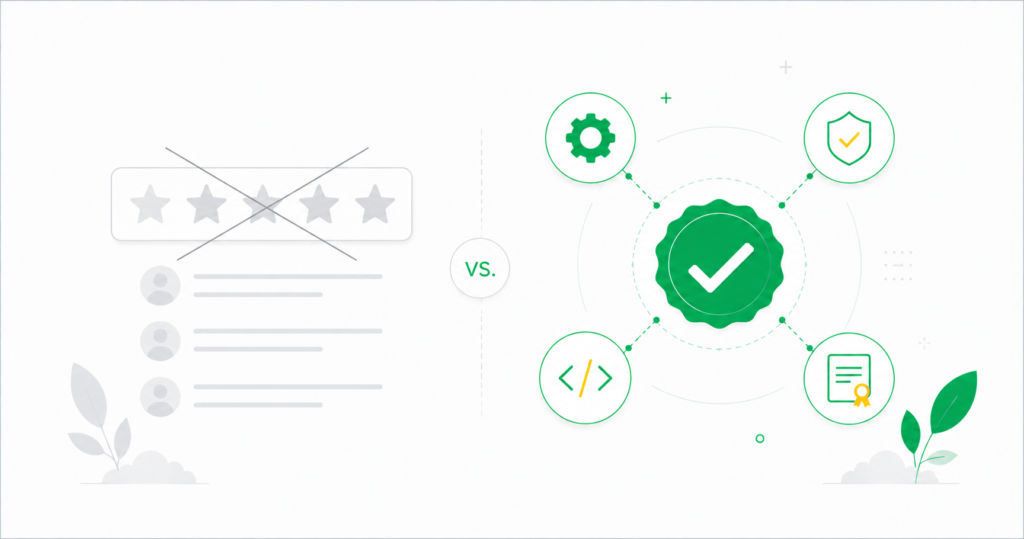
In short. Vietnam Tech Partners doesn’t rank teams by star ratings or reviews — those are easy to fake and hard to verify. Instead, we verify each team (legal registration, delivery evidence, certifications) and compute scores from real, structured signals: the technologies they actually use, certifications we can confirm, delivery history, security posture and platform footprint. Missing data is re-weighted, never invented. Placement is never for sale. This page explains exactly how that works, so you can trust what a score means.
Why reviews fail buyers
Reviews feel reassuring, but for high-stakes B2B decisions they’re among the weakest signals available. They’re cheap to manufacture, easy to suppress, and increasingly generated by AI. The problem became serious enough that the US Federal Trade Commission issued a rule — effective 21 October 2024 — that bans selling or buying fake reviews, paying for reviews with a required sentiment, undisclosed insider reviews, and company-controlled sites that pose as independent. In December 2025 the FTC sent its first round of enforcement warnings. Penalties can reach tens of thousands of dollars per violation. When a government has to legislate against fake reviews, building a directory on them is building on sand.
There’s a deeper issue too: even genuine reviews don’t tell you whether a team can do your work. A five-star review of a marketing site rebuild says nothing about whether that team can ship a production RAG system or pass a security audit. We score capability, not sentiment.
Step one: verification
Before a team is scored or listed, it clears a verification process — the same checklist we recommend buyers run themselves:
- Legal existence: confirmed on Vietnam’s National Business Registration Portal (registration, tax code, status, legal representative).
- Delivery evidence: real, contactable references and specifics, not just a portfolio.
- Certifications: ISO 27001, SOC 2 and similar, confirmed at the source.
- Security & infrastructure: where code and data live, and on what.
Crawled or AI-assisted data is treated as a draft until a human verifies it — automated extraction speeds up data entry, it never substitutes for verification. See the buyer-facing version in how to vet a Vietnamese software company.
Step two: the scoring engine
Once verified, a team is scored on two layers, both computed from structured signals — never from reviews.
Composite pillars
Seven headline scores summarise the team:
| Pillar | What it reflects |
|---|---|
| Trust | Verification depth, legal substance, certifications, security posture |
| Technical | Depth and breadth of verified technology capability |
| Delivery | Evidence of shipped work and delivery maturity |
| Reputation | Verifiable external signals (not anonymous reviews) |
| Market | Markets and industries served, engagement footprint |
| Brand Maturity | Professional presence and collateral — here, absence is treated as a real low-maturity signal |
| Overall | A weighted blend of the above |
Capability-area scores
Because “good at software” is too vague to act on, we also score capability by area — AI, Cloud, DevOps, Security, Data, Mobile, Web, Blockchain, Game and Enterprise, plus delivery and partner maturity. These derive from a capability graph: the team’s verified technologies map to areas (for example, RAG, LangChain, PyTorch and computer-vision signals raise the AI score; AWS, Azure and Kubernetes raise Cloud), weighted by proficiency and corroborating signals. That’s the AI score you see ranking teams in our verified AI companies list.
How we handle missing data
This is where most scoring systems quietly mislead. When an input is missing, we re-weight the remaining signals (renormalise) rather than scoring the gap as a zero — penalising a team for data we simply don’t have yet would be unfair and inaccurate. The one deliberate exception is Brand Maturity, where a genuine absence of professional presence is itself meaningful, so it isn’t re-weighted away. We never invent a number to fill a gap.
What we deliberately don’t do
- No reviews or star ratings feed any score, and we don’t publish third-party review/aggregate-rating markup.
- No pay-to-play: a team cannot buy a listing, a higher score, or a better rank.
- No fabricated data: unverified or unreliable fields (including any ratings produced by automated tools) are dropped before they can reach a score.
- No scraping of third-party directories for ratings or reviews.
[Add a one-sentence quote from VTPN’s founder/verification lead on why you chose computed verification over reviews — an original quote earns AI citations and anchors the brand.]
Keeping scores honest over time
Scores are recomputed when a team’s verified signals change, and verification is re-checked periodically. A score is a snapshot of evidence, not a permanent badge — if the evidence changes, so does the score.
See it in practice
Every team profile shows its computed pillars and capability-area scores, with the line “computed from verified signals — not self-reported.” Start with the directory, or tell us what you’re building and we’ll match you with verified teams within one business day.
Get matched with verified teams →
Frequently asked questions
Do reviews affect VTPN scores?
No. No anonymous reviews or star ratings feed any score. We compute scores from verifiable, structured signals such as technologies, certifications, delivery evidence and security posture.
Can a company pay for a higher score or ranking?
No. Placement, scores and ranking can’t be bought. Scores are computed from evidence, and ranking follows those computed scores.
How do you handle missing information?
We re-weight (renormalise) the remaining signals rather than scoring a gap as zero, so a team isn’t penalised for data we don’t have. The exception is Brand Maturity, where a genuine absence is a real signal. We never invent numbers.
What does the AI capability score mean?
It reflects a team’s verified AI-relevant technologies and signals (e.g. RAG, LLM tooling, ML frameworks, computer vision), weighted by proficiency — not self-description. It’s what ranks teams in our verified AI list.
Why don’t you just use star ratings like other directories?
Because they’re unreliable for B2B decisions and easy to manipulate — the FTC banned fake reviews in 2024 and began enforcement in 2025. Verified, computed capability is harder to fake and more useful for choosing a team.
About this page. It describes Vietnam Tech Partners’ own verification and scoring methodology. External references (FTC Consumer Reviews and Testimonials Rule, 2024–2025) are cited for context. We never present Vietnam as “cheaper than India” or publish fabricated numbers.